


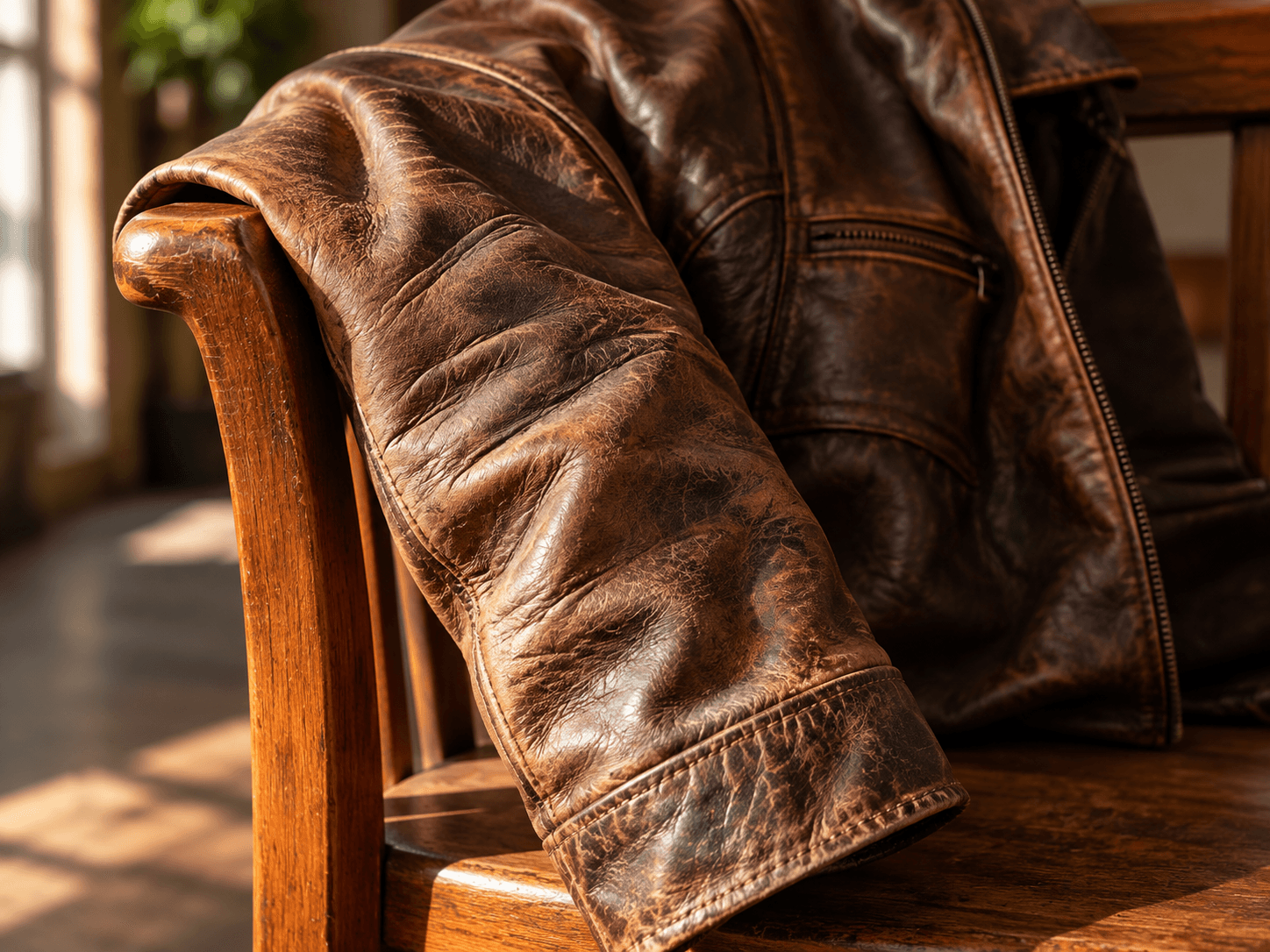
A well made leather jacket outlasts almost anything else in a wardrobe, but “how long” depends on the leather, how it is worn, and how it is looked after. Here is what actually determines a jacket’s lifespan and how to tell when it is genuinely worn out rather than just broken in.
What determines how long it lasts
The leather itself
Full-grain cowhide is the most durable option and can last decades with basic care, since nothing has been sanded away from the surface that would otherwise protect it. Lambskin is softer and more comfortable but wears faster, since it is thinner to begin with. Genuine leather, despite the name, is the least durable grade and tends to crack or peel within a few years rather than developing a patina.
How often it is worn
A jacket worn daily flexes at the elbows, shoulders and cuffs far more than one worn occasionally, and that repeated flexing is what eventually breaks down the fibers in the hide. This is not a reason to avoid wearing it, just a reason to expect an everyday jacket to show wear sooner than one kept for weekends.
Care and storage
Leather that dries out cracks. Leather that is conditioned two or three times a year and kept away from direct heat and damp stays flexible for far longer. Storage matters almost as much as cleaning: a jacket left folded in a bag develops creases that never fully drop out, while one hung on a wide hanger keeps its shape.
Signs it is actually worn out
- Cracking or flaking on the surface, rather than just a soft patina sheen. Patina darkens and softens the leather; cracking breaks the surface.
- Stiff, brittle patches that do not soften with conditioning. This usually means the fibers underneath have broken down, not just the surface finish.
- Seams pulling apart or stitching visibly fraying at stress points like the underarm and cuffs.
- A hardware failure that is cheaper to replace than repair, such as a zip that no longer catches or snaps that have worn smooth.
A jacket with scuffs, creases or color that has darkened with wear is not worn out. That is patina, and on full-grain leather it is generally considered a feature, not a flaw.
Getting the most life out of one
Wipe it down after wear, keep it away from radiators and direct sun, and condition it two or three times a year rather than only when it looks dry. Store it on a proper hanger, not folded. A jacket cared for this way from day one will often outlast the person who bought it.
Shop men’s and women’s leather jackets, and see our guide on cleaning, conditioning and storage for the full care routine.